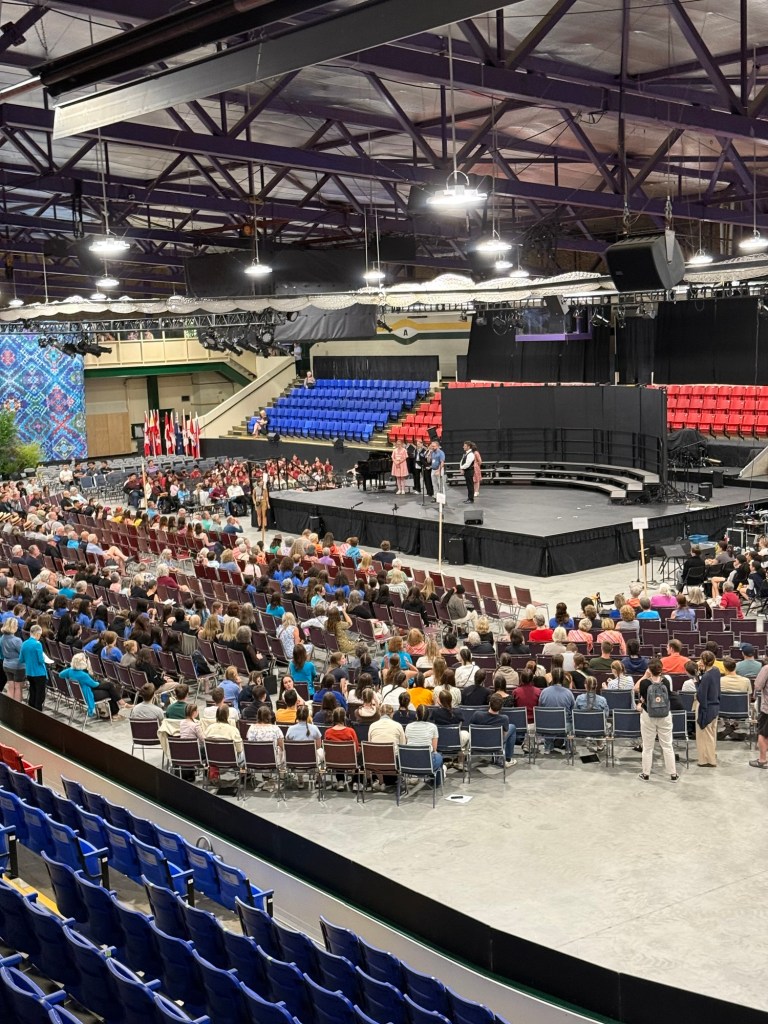
Every two years, Powell River, the small town I live, hosts an international choral festival called Kathaumixw. It is, I was told, the only international choral festival in Canada. Kathaumixw means ‘gathering of different people’ in the local indigenous language.
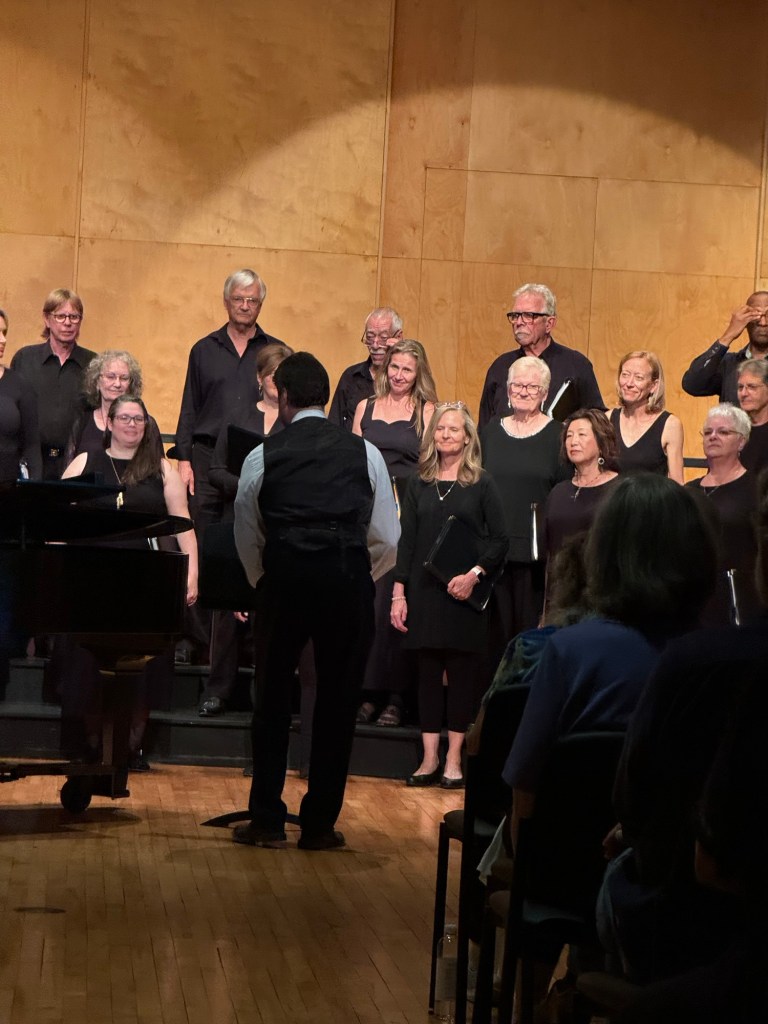
It’s been around for 40 some years, and apparently this year was the 20th festival. Canada’s Independence Day, July 1, was the opening day and it literally filled the small town with choral music for 5 full days. The participating choirs came from not only Canada and USA, but also Costa Rica, Slovenia, New Zealand, Philippines, and Taiwan. My choir was the festival host choir. What a super-hectic, super-stimulating, super-exciting, and super-exhausting 5 days!
When the festival was over, I found myself in a somewhat stunned or ‘out of it’ state. My heart was crying out…”no, I don’t want it to end!” “Let me linger in the exhilaration!”, then slowly turned to ”I am so sad”, “l’m missing the excitement already”….
Especially the final concert was so inspiring to my heart. For four days since the festival opened, almost 1000 singers, learned the three beautiful choral pieces together, and rehearsed together, under the direction of Dr. Zimfira Poloz. Dr. Zimfira is the director of the Toronto Children’s Choir and a well-known well-respected educator in Toronto. I got to learn so much from her.
Dr. Zimfira told us a bit of her life story. She was an immigrant (refugee?) from Kazakhstan. When the USSR had collapsed, she and her husband emigrated to Canada. They were concerned about their future in Kazakhstan and Canada was one of only two countries in the world willing to welcome them. Their life in Canada was not easy, but every time they were given opportunities or challenges they felt so grateful. She said she would never take anything for granted.
Wow, she went through a similar path as an immigrant as myself, I thought. Of course, I immigrated from Japan which is a peaceful and stable country, and I didn’t have to be concerned with my security or my future. However, to a woman from Japan with hard-to-pronounce name, and not especially talented in anything, Canada gave me opportunities to build a decent life. I met many good hearted people. Abundant nature, peaceful country, clean air, warm kind friends…I feel so grateful.
So now, the festival is over. The town is back to normal getting ready for the tourist season. I run into my choir mates in town, we say to each other, “I can’t get those 3 pieces out of my head…..They are still ringing in my head.” Aren’t we lucky?
Music is the only language that has power to speak directly to our heart. Music can unite people instantly. I want to say my heart-felt “thank you” to my late parents who initiated music education for me 60+ years ago. And “thank you” to our beloved town of Powell River that included me in its music community.
Opening concertFirst rehearsal of 3 common songs 参加者全員での最初のリハーサルConcert コンサートAfter the concert with my granddaughter Sumi and her friend コンサートの後で
My father’s funeral was held at his church in Tokyo. It was a Christian service. Although the minister of the church had never met my father, he performed a heartfelt, sincere service that I truly appreciated.
Although I appreciated the funeral service, I didn’t feel peaceful about everything else after the service. The farewell staging was so pretentious that it left me cold. I have to note that it was after the church service and it had nothing to do with the minister or the church.
The farewell staging, or final goodbye, included some discomforting rituals.
The funeral director from the undertaking company, for example, told us to stroke my father’s face to express our love. The family members all stroked the icy cold face.
I also felt awkward sitting in the hearse which was driving off from the church while a group of people singing hymn were seeing it off. It reminded me of a scene from a century old black & white movie. The hearse carried my father and us to the crematorium.
And more dreadful ritual was that the family members picked up his burnt bones with chopsticks and placed them into the urn.
It didn’t sit well with me at all. I felt extremely uncomfortable. People say it’s just how funerals are conducted in Japan. It’s one of those cultural things. It sure is a big cultural difference. But it was not just that. Something was making me feel uneasy. What was it? I kept wondering.
It’s been almost 3 months passed since that funeral day. Thinking back now, I feel that the reason I felt so uneasy could be coming from my fundamental lack of understanding.
What is the objective of the funeral? I feel that in Japan the focus of the funeral is on “death”. It reminds us over and over that the person is now dead.
The focus of a funeral in Canada, where I have been living for the last 35 years, is more on “life”. The life the person lived is remembered.
I still remember how the cold face felt on my palms. It was something I didn’t want to remember. I wanted my father to be alive in my memory until the day I die. I wanted him to be a healthy lively person with a warm and beautiful soul, not a cold corpse or fragile bones.
Experiencing such a cold face would be too shocking for my little grandchildren. I worry that they would only remember that coldness rather than the warm smile and beautiful bass voice of their great grandpa who loved them.
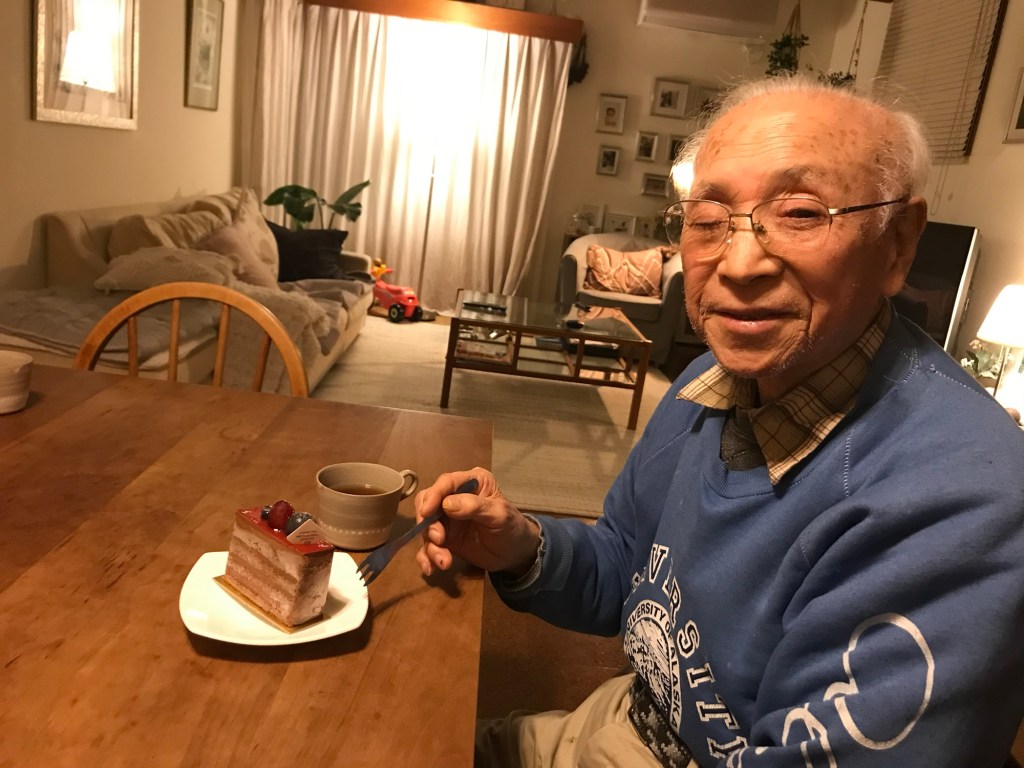
My father lived more than 13 years after my mother passed. He lived to be almost 97 years old. People say, he had a long happy life. Yes, for sure, he did have a long life. However, his last 13 years must have been terrible. I cannot believe he had ever felt anywhere near “happy”. Perhaps some natural defense mechanism had kicked in, possibly in order to blur his loneliness, his memory had started to deteriorate little by little. It eventually took away his ability to recognize us, his family faces. He could not remember us despite our strong kinship. He had dementia.
Dementia is a terrifying disease. I read an article about it describing what it would be like. Imagine sitting in an airplane all by yourself, not knowing why, definitely not because you want to go somewhere. The plane takes off and lands somewhere and you have to get off. You see people everywhere, surrounding you and talking. But you don’t know anybody. You don’t understand a word they are saying. You feel helpless, you don’t know what to do. Some people look aggressive, and you feel they may harm you, but there is no way of defending yourself. You are totally alone.
My father must have felt like this for the last several years, fearful and devastated. How terrifying it must have been.
I am sad I was helpless, powerless and worthless for him. I couldn’t do anything. I couldn’t even be physically with him, just sit with him, help him feel at peace. Of course I was living far away, but still…..
My father was the person who was always quick to help me when I got in trouble, in tears, or feeling lost and overwhelmed. He was also quick to celebrate my joyous moments, flying to wherever I was.
It hurts to recognize that I was utterly useless when my father needed me the most, and there is no other chance left for me to make it up.
Last year I suffered from terrible sciatica…perhaps caused by my lack of exercising (?). In any case, I promised myself, “never again”! I was determined to work on becoming fitter. I began with muscle training. I attend fitness classes almost everyday. A class called “Strength and Core” is held on Monday mornings at the Powell River Rec Centre. There are many fitness classes offered there, but I find this class most effective for me.
Of course, there are many other like-minded people who also come to this class. Although demanding and exhausting, the class is very popular. In order to secure a favorite spot, people typically arrive 30 minutes before the class, go straight to the spot and spread their mat. It’s funny…some people like to be close to the instructor; some want to be closer to the wall, some want to have the best view of themselves in the mirror…etc. I like to be in the front row, close to the mirror, and close to the instructor.😆 I’m also one of those people who arrive early before the class, and spread my mat at the right spot. I love to be perfectly prepared.
And, one day….the class was just starting….music came on….bodies began to move….. just at that moment, a tall guy with fuzzy hair arrived to the class. He was perhaps in his 50s, perhaps with some kind of mental/cognitive challenge. He walked right into the class, and walked straight toward where I was. He said to me, “you are in my spot.” Apparently, he usually comes on Tuesdays, and the instructor is reserving this spot for him. I almost said “No, this is my spot!”, but I didn’t. Instead, I just nodded, moved my mat, and let him take my spot. I thought, since he might have some kind of disability, I better let him do whatever he needed. Later on, some of my classmates said to me, “You didn’t have to give him your spot”. Of course I didn’t have to, but I felt I did the right thing.
A few days later, I ran into this guy on the road. I said “Hi!” with my usual smile. His face was motionless. He looked rather nervous and murmured something to me. “What?” I couldn’t hear him. He said, “do you want to go to the Chinese restaurant in the mall nearby?” I was surprised, not expecting such an invitation. What should I say to him? My mouth stumbled….“Uuuum… I have to go home right away.” He nodded and kept on walking. I felt sorry and walked away, but kept on thinking, “did I do the right thing?”
Was I mean? The guy perhaps has no friend….he might have thought I could become his friend. It might have required so much courage for him to talk to me. And no doubt, he thought he was rejected…actually that was true…I did reject him. I’m sorry. When I put myself in his shoes I could really feel his pain.…
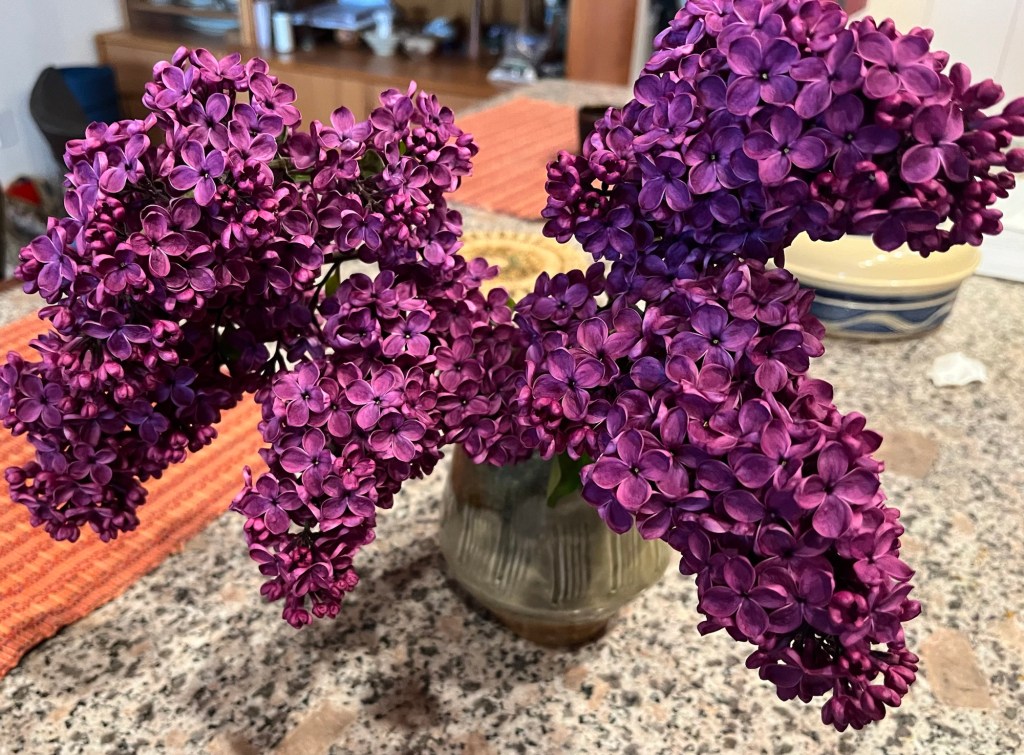
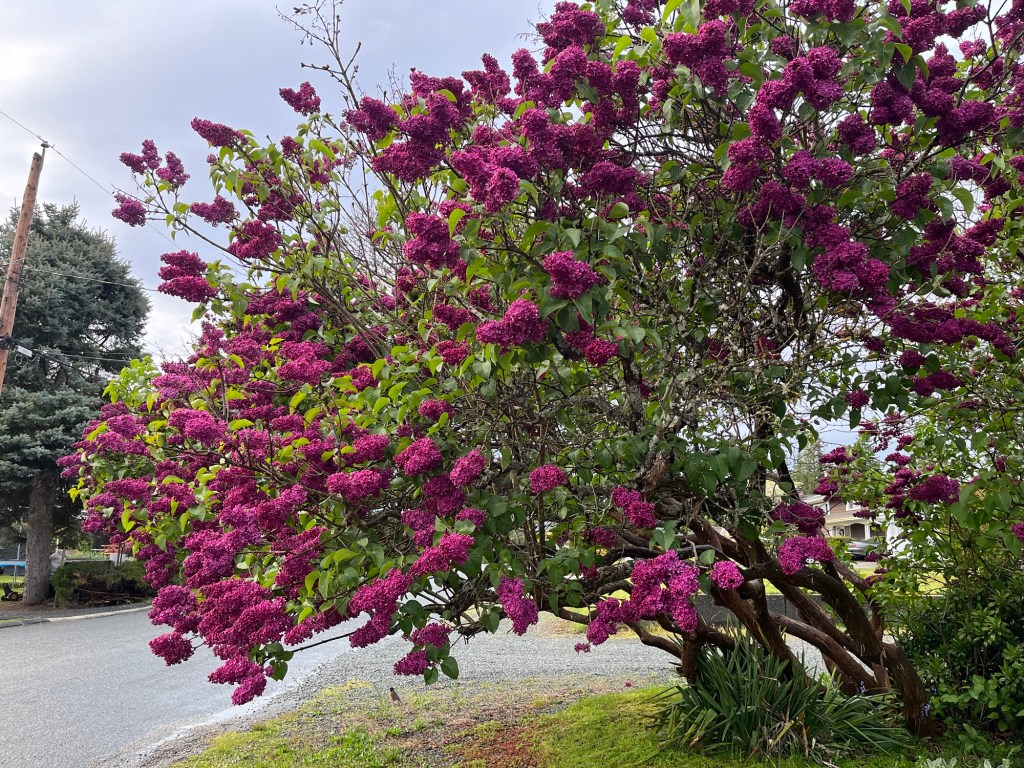
Lilacs
昨年、坐骨神経痛なるものにかかって大変苦しい思いをした私。2度と同じ苦しみを味わいたくないと筋肉をつけるトレーニングを始めた。パウエルリバーの市が経営するフィットネスのクラス、いろいろある中で私は月曜日の朝のStrength and Coreというクラスが特に気に入って毎週行くようにしている。
I live in Canada, a nation known to be one of the most culturally diverse. However, the major stream of its racial profile is white Caucasian. No doubt about that. So it is a country of European descent people wherein other races, yellow, red, brown, and black people are mixed in. In the countryside, like Powell River where I live, there are way less Asians. Unlike some areas like Vancouver or Richmond, Asians in Powell River are definitely a minority.
Several months ago, I had a lovely lunch with my new friend. She is a Caucasian in her late 60s or early 70s, an intelligent woman with a warm compassionate aura. She seems to emanate loving and caring light, and I truly admire her. So at this lunch, although I can’t remember what we were talking about, in the middle of our conversations she opened her eyes wide and said, “oh, that means….how old are you?” So I said, “67” I have no reason to hide my age. She looked genuinely surprised. “What? So you are of the same generation as I am. I had thought you were in your 40s.” It was my turn to open my eyes wide. “What? Wow… I’m so happy. You made my day!” So as you can imagine, I had a wonderful rest of the day, smiling and humming.
The next day, when I went to my usual fitness class, there was a non-regular person, an older Caucasian woman participating in the class. As soon as she saw me, she said, “are you Emily’s mother?” I was stunned. Emily is a slender Chinese-Canadian woman around my age. “What? No way!” Although pretending like it was no big deal, I was offended like crazy….with my chest burning with anger and shock.
What a change in just one day!!
Recently, I read an article about how hate and racism toward Asians are increasing. It had been boiled up by the Covid turmoil and has been persistently continuing.
After the class I said to Emily “somebody asked me if I am your mother.” Emily laughed and said, “she has probably had no Asian friends in her life. There are a lot of people like that. They merely don’t know or not interested in knowing Asian people.”
I thought Emily’s reaction was pretty cool. Yes, she is right. This is not even racism…it’s only a phenomenon coming from ignorance. It made sense to me.
I’ve read somewhere that the discrimination toward Japanese Canadians around the time of WW2 was ignited by the fear coming from ignorance of the general public about Japanese Canadian people. Ignorance is dangerous and could end up in sad situations.
So if you make friends with people from many different cultures, would the world be more peaceful?
I don’t know. It doesn’t seem that simple, does it?
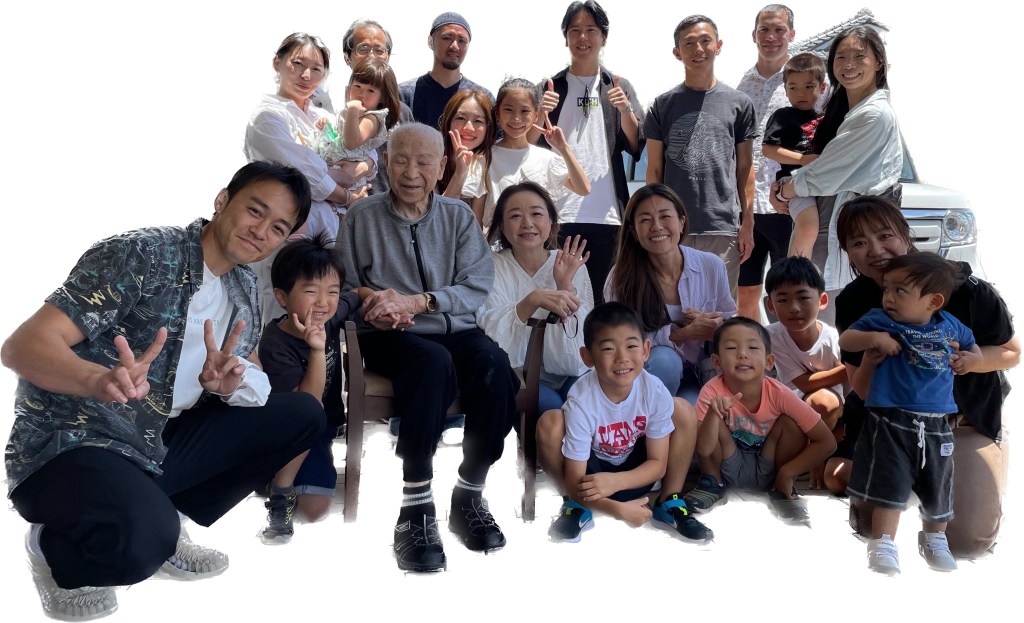
My 95 year old father surrounded by his children, grandchildren and great grandchildren. Only missing is me!
数ヶ月前だったかこんなことがあったよ。新しく出来た友達といっしょにランチした時のこと。その友達は知的で優しいオーラに包まれた白人の女性、60代後半か70代前半くらい。何を話していた時か覚えてないけど、話の途中で彼女が「え?」と大きく目を見開いた。「ということは…え?…あなた何歳?」と聞いて来た。もちろん何も隠すことないから正直に「67歳よ」と答えたら「え?じゃあ私と同年代じゃないの。私はまたあなたは40代かなと思っていたわよ。」と言われて今度は私の方が「ええ?」と目を見開くことになった。「そんな…嬉しい!わあYou made my day!」と言って笑った。そしてご想像の通りご機嫌よろしく鼻歌まじりにその日1日を過ごした。
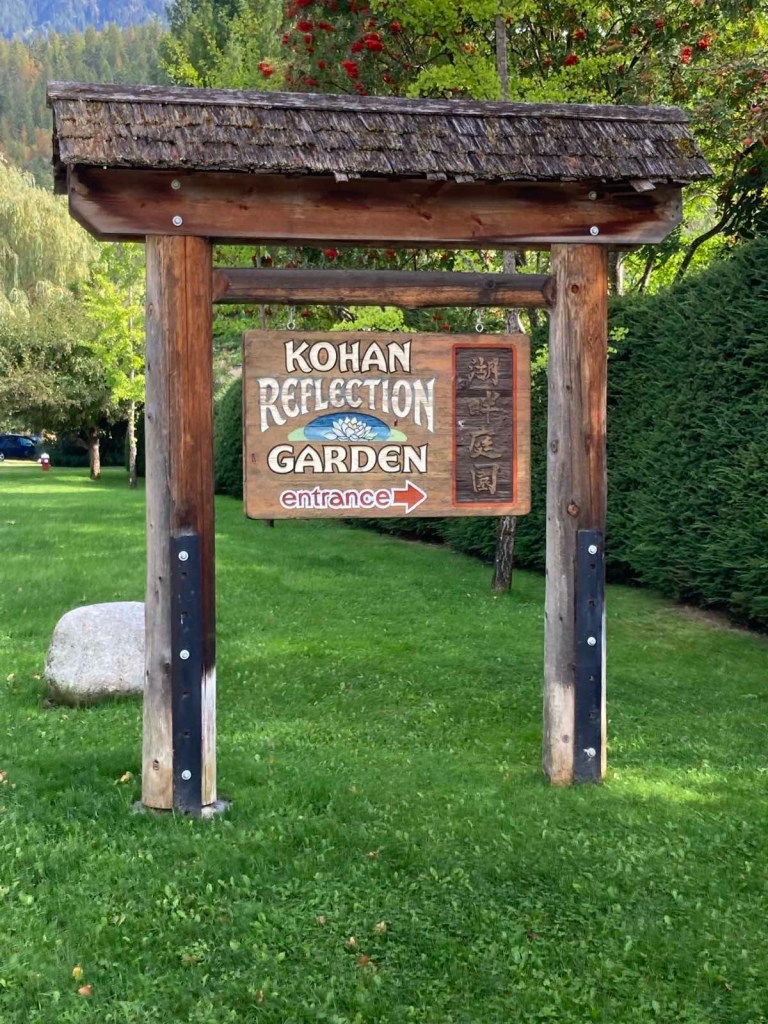
Recently, we watched a program on the Knowledge Network about Japanese gardens in Canada. UBC Nitobe Garden in Vancouver, Japan Canada Yukoo Garden in Lethbridge, Alberta, and Kohan Reflection Garden in New Denver, B.C. were introduced. There were some explanations of who, how, and why these gardens were created. Histories, ideas, and some background behind these gardens were briefly mentioned.
I have to confess that although I have 32 long years of living in Canada, somehow, I never had the chance to learn or even be interested in the history of Japanese Canadians. Watching this program was an eye opening experience for me.
We had a long and beautiful summer this year. Neil and I were thinking of going somewhere on a driving trip with our two dogs before rain arrived. It would be perfect to go to New Denver to visit the garden and learn the history.
When I told our dear friend, Allen, about this idea, he said I must read Obasan by Joy Kogawa before the trip. It was indeed excellent advice!
So a sunny day in mid September, we departed our house in Powell River and started our week-long driving trip to the interior of BC.
New Denver was far. We stayed at a motel in a quiet little village called Fauquier after crossing Arrow Lake by a cable ferry.
We arrived in New Denver the next day. It is a picturesque old little town by Lake Slocan. Nikkei Internment Memorial Centre and Kohan Reflection Garden were on the other side of a river, separated from the town by a bridge.
We saw a big bear in the park near the Kohan Garden, devouring something from a garbage box.
In this quiet old town about 1,400 people live. There are some more small villages and ghost towns in this area surrounded by mountains and lakes. It was hard to believe that in the 1940’s 22,000 Japanese Canadians were squeezed in this small area.
They were all uprooted from their houses and businesses on the west coast of BC. They were first stuffed in the smelly animal sheds in Hasting Park in Vancouver for months, then brought to Slocan by train, then to New Denver area by boats. Amazingly, 75% of those people were Canadian born or naturalized Canadian citizens!! Men between ages 20s to 60s were sent to physical labor camps, forced to construct railroads or highways. Women, children, and older people were sent to these internment camps.
…..What?…. I have heard that many Chinese laborers were brought from China to work on the railroad constructions. I didn’t know Japanese Canadian men were forced to work in such construction sites as well……Many of them were fishermen or farmers. They were removed from their works, properties, and families, and shipped to work in those constructions….and they were all legal Canadians… how terrible….I didn’t know….
Their properties which they had worked so hard to earn …including tools, boats, cars, radios….were taken away, looted, and auctioned off. The government approved to sell their belongings, THEN charged them the handling fees for selling!
They could not return to their houses… ever. They were not even allowed to exist in the west coast of BC for several years even after the war.
People were allowed to take their necessities as much as they could carry by hand. They had to watch from the bus windows as their houses were looted as their buses drove away.
Apparently, discriminations towards Japanese Canadians started way before the Pearl Harbour. There were various systematic legal discriminations against them, e.g., taking away and banning their rights to obtain fishing license, not allowing them to engage in certain occupations like lawyer, medical doctor, teacher….etc. As they became successful in their fields, regulations were put on to prevent their success. The systematic discriminations were already escalating and broadening by the time Pearl Harbour happened. Pearl Harbour only provided a good reason for their removal.
They were Canadian citizens whose ancestors came from a country which happened to become an enemy…just like German Canadians or Italian Canadians. Imagine the lives of immigrants; they must work extra hard from zero in the new land, in an unknown environment, with an unfamiliar language, to build up their means of survival. And then everything they had built was taken away…just to make them suffer….just because they were Japanese descendants………..
Older people, children, and women were sent to interior BC like New Denver. They had to live through the first winter in thin canvas tents. Materials and tools to build the camp did not arrive for many months.
How did young mothers with babies live without privacy? How did sick people survive in such poor conditions?
There were voices amongst white Canadians, “Japs deserve to suffer, they should suffer to the maximum”
This is certainly not the Canada I know. How sad…
After the war was ended, Japanese Canadians were uprooted again. They were forced to make a choice of moving further east and work in places like sugar beet farms, or board ships taking them back to Japan.
For most of the Canadian born people, Japan was a foreign country. They didn’t speak the language or have anybody who could help them. Moreover, Japan was in total chaos. Many cities were bombed out heavily, people had lost their places to live, no food to eat….they themselves were struggling to survive.
Despite all that, many Japanese Canadians chose to board the ships out of deep despair. They felt there was no future, no hope for them in Canada.
After people left New Denver, the internment camp was bulldozed over to a bare field, as if nothing had happened… In 1989, the Japanese garden called Kohan (it means Lakeside) Reflection Garden was created. A young garden designer from Japan transformed this land of tears and sorrows to a beautiful garden. It is now a public space, open to everybody.
Beautiful town, beautiful park, with a sad history….
This was such a moving trip. I am still reading more books about the Japanese Canadian history. I would love to go back there again.
The other day Neil and I went to a bank to open a GIC account. A young handsome guy working in the bank sat with us, explained options, and went through a lengthy procedure, and finally we were done. We stood up to say good bye, and at that moment….don’t know why….but I said to the guy something totally irrelevant.
“Thank you for saying my name right. I have been impressed that you pronounce ‘Haruyo’ so well. Not many people can do that…you know.”
The young lad’s face instantly lightened up. “Ever since I was a kid I was an enthusiastic fan of a Japanese animation called Captain Tsubasa. There were times I actually told people that my name was Kakero!”
“I would love to go to Japan. It has been my dream for a long time!” etc. etc.
So… we sat down again and listened to his story.
He said, when Genghis Khan invaded northern Pakistan in early 12th century, some Mongolian soldiers stayed back in the region. Their descendants still live there today, and he was one of them. His ancestors were Mongolian. He was born and raised in Pakistan, but was educated in England. Now, he is a Canadian!
Wow….what an interesting background! It sounds so much like Canada!
Then, I thought. Wow, well….then, what am I? What’s my identity?
Yes, my parents are Japanese. I was born and raised in Japan. So, racially, I’m a Japanese. At age 13 I moved to USA and lived my formative years there from Grade 8 to University Freshman. I went back to Japan at age 18, finished my undergraduate, got married to a Japanese man, and gave birth to 3 children. When the children were 8, 6, and 3 years old, we moved to Canada and it’s been 30 years since. In that time, my marriage broke down, I got divorced, and my children grew up with me in Canada. I studied in graduate school, worked in education, building, and music fields, raised my children, and remarried a Canadian person 20 years ago. I still have a Japanese passport, but my life is centered in Canada, and I am a permanent resident of Canada.
Hummmm…. so? I know for sure that I’m not an American.
Then, am I Japanese or Canadian?
2 weeks ago when I was coming back from Japan, I noticed in the plane that the screen in front of my seat showed where we were flying. It was about 30-40 minutes before the arrival time. The screen said “Comox”. What? Comox? So are we flying just above Comox? Thick dark clouds were hiding any views downwards. Then the screen showed “Powell River”. Right between Comox and Powell River there is Texada Island.
Straight below me lies my beloved Texada Island!! I am back….!!
Non-describable feelings of joy and excitement slowly bubbled up from somewhere deep in myself. I was surprised to realize such a reaction.
I am a person with Japanese face, with families in Japan. I love Japan…people, culture, food….everything about Japan. Yet, I deeply love Canada. It felt like I had an epiphany moment to realize that I might already be a Canadian at heart.
Whatever that was, Japan and Canada are both beautiful, caring, respectful, and sincere nations. So wonderful that there are people waiting for me in both countries. What Blessings!





 pocoapocowithsmile