
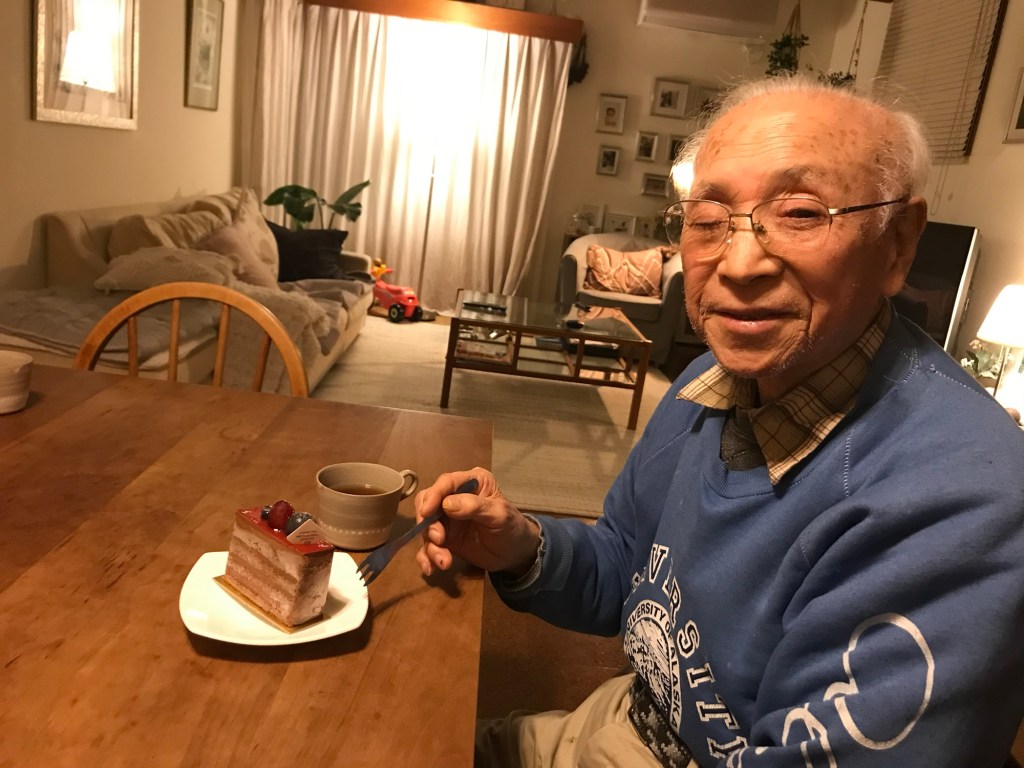
My father’s funeral was held at his church in Tokyo. It was a Christian service. Although the minister of the church had never met my father, he performed a heartfelt, sincere service that I truly appreciated.
Although I appreciated the funeral service, I didn’t feel peaceful about everything else after the service. The farewell staging was so pretentious that it left me cold. I have to note that it was after the church service and it had nothing to do with the minister or the church.
The farewell staging, or final goodbye, included some discomforting rituals.
The funeral director from the undertaking company, for example, told us to stroke my father’s face to express our love. The family members all stroked the icy cold face.
I also felt awkward sitting in the hearse which was driving off from the church while a group of people singing hymn were seeing it off. It reminded me of a scene from a century old black & white movie. The hearse carried my father and us to the crematorium.
And more dreadful ritual was that the family members picked up his burnt bones with chopsticks and placed them into the urn.
It didn’t sit well with me at all. I felt extremely uncomfortable. People say it’s just how funerals are conducted in Japan. It’s one of those cultural things. It sure is a big cultural difference. But it was not just that. Something was making me feel uneasy. What was it? I kept wondering.
It’s been almost 3 months passed since that funeral day. Thinking back now, I feel that the reason I felt so uneasy could be coming from my fundamental lack of understanding.
What is the objective of the funeral? I feel that in Japan the focus of the funeral is on “death”. It reminds us over and over that the person is now dead.
The focus of a funeral in Canada, where I have been living for the last 35 years, is more on “life”. The life the person lived is remembered.
I still remember how the cold face felt on my palms. It was something I didn’t want to remember. I wanted my father to be alive in my memory until the day I die. I wanted him to be a healthy lively person with a warm and beautiful soul, not a cold corpse or fragile bones.
Experiencing such a cold face would be too shocking for my little grandchildren. I worry that they would only remember that coldness rather than the warm smile and beautiful bass voice of their great grandpa who loved them.
My heart sank. It was the saddest day of my life.
父のお葬式はキリスト教の教会で行われたとはいえ、日本の典型的なお葬式であったことは歪めない。日本のお葬式とカナダのお葬式はなんだか根本的に違う気がする。お葬式の式自体は、父に会ったこともない牧師さんだったとはいえ、心のこもった誠実な式だったと思う。
でも式の後のお別れの演出が何ともわざとらしくて嫌だった。例えば葬儀社の人が、親族の人たちに、冷たくなった父の顔を撫でるように誘導したり、霊柩車を見送るときに讃美歌を歌いながら見送ったり…。そうしてそのまま火葬場に行ってお骨拾いをしたり…。
何か違う、なにかそぐわない気がして抵抗感があった。もちろん文化の違いだと言われればその通りだと納得せざるを得ないのかもしれない。でも何か違う。何だろう、どうしてこんなにモヤモヤするんだろう、とずっと考えていた。
3ヶ月たった今思うと、結局、根本的にお葬式の意義というか、目的というか、フォーカスのようなものが私の知っているカナダのお葬式とは違うような気がするのだ。つまり、日本のお葬式は『死』がフォーカスであるのに対してカナダのお葬式は『生』がフォーカスなのかもしれないと思った。日本のお葬式がその人が死んだことを、これでもかこれでもかと強調するのに対して、カナダのお葬式はその人の生きた人生を強調する。もう35年もカナダに住んでいる私はそういうカナダの感覚に慣れきっているのかもしれない。
私は正直言って冷たくなった父の顔を撫でてその冷たい感触がずっと手を通して私の中に記憶されるのに抵抗を感じる。父は私の記憶の中でずっと生きていてほしい。いつまでも元気で温かい父の感触を覚えていたい。死んで骨になった父ではなく、生きていた元気な父をいつまでも覚えていたい。孫や小さな曾孫が曾祖父さんのことを、触ったときの氷のように冷たい感触として覚えるのではあまりにもせつないではないか。温かい笑い顔を、美しい低音の声をいつまでも覚えていてもらいたい。
無性に切なくて胸が痛む1日だった。
 pocoapocowithsmile